Post-Laminectomy Syndrome
Post-laminectomy syndrome — also called failed back surgery syndrome — is persistent or new pain after spine surgery. It is treatable, often without another operation.
About Post-Laminectomy Syndrome
Post-laminectomy syndrome, also known as failed back surgery syndrome (FBSS), describes persistent or recurrent pain after spine surgery such as laminectomy, discectomy, or fusion. The pain may be similar to the pre-operative pain, or it may be a new pattern altogether.
Common contributors include epidural scar tissue around nerve roots, recurrent disc herniation, spinal instability or adjacent segment disease, incomplete decompression, and persistent neuropathic pain. A second surgery is rarely the right answer — most patients improve with a structured, non-surgical plan.
Common symptoms
- Persistent lower back pain after surgery
- Burning or tingling nerve pain (neuropathic pain)
- Pain that returns after initial post-surgical relief
- Reduced range of motion and spine stiffness
- Radiating leg pain and muscle weakness
What causes post-laminectomy syndrome
Scar tissue formation around nerve roots (epidural fibrosis)
Recurrent herniated disc after surgery
Spinal instability or adjacent segment disease
Nerve damage during spinal procedures
Incomplete decompression or surgical complications
How we identify it
Accurate diagnosis comes first — so every treatment is aimed at the true source of pain.
- 01Comprehensive physical and neurological exam
- 02MRI, CT, or X-ray imaging of the operated levels
- 03EMG testing for nerve damage assessment
- 04Diagnostic nerve blocks to identify pain generators
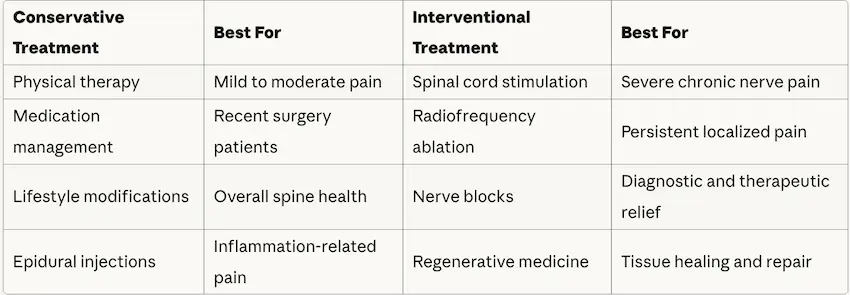
How we treat post-laminectomy syndrome
Epidural steroid injections
01Image-guided medication delivery to calm inflammation around irritated nerve roots.
Learn moreNerve blocks and radiofrequency ablation
02Targeted treatment for facet-mediated and nerve-related post-surgical pain.
Learn moreSpinal cord stimulation
03An implanted device that interrupts pain signals — a well-established option for failed back surgery syndrome.
Learn moreRegenerative medicine
04PRP and stem cell therapy for select patients with ongoing degenerative contributors.
Learn moreSpecialized physical therapy
05Post-surgical rehabilitation focused on stabilization, mobility, and graded reconditioning.
Learn moreWhen to see a specialist
See a pain specialist if pain persists or returns after spine surgery, if you develop new neuropathic symptoms, or if you are being offered another operation and want a second opinion on non-surgical options.
Book Free ConsultationAll common symptoms
- Persistent lower back pain after surgery
- Burning or tingling nerve pain (neuropathic pain)
- Pain that returns after initial post-surgical relief
- Reduced range of motion and spine stiffness
- Radiating leg pain and muscle weakness
Get expert care for post-laminectomy syndrome
Request a consultation and our specialists will identify the source of your pain and build a treatment plan around it.